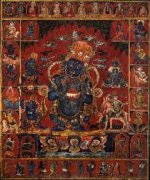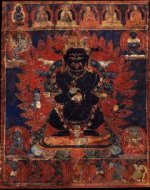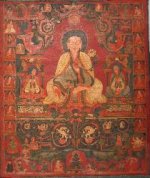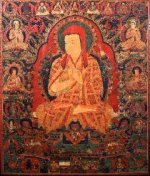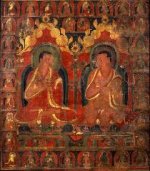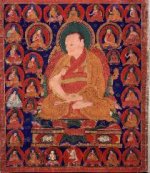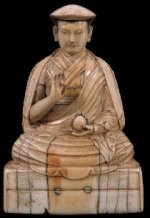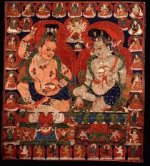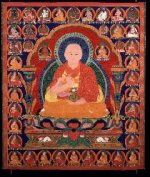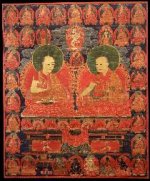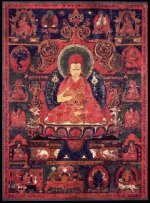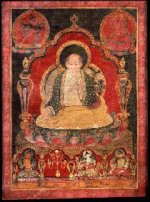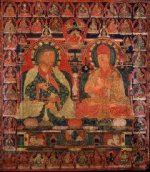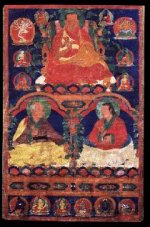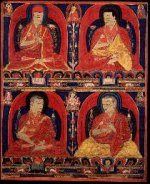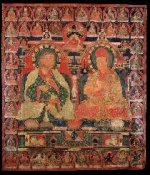
The Sakya (sa skya) tradition was founded by Khon Konchok Gyelpo in 1073, a date marked by his founding of Sakya temple in the Sakya valley in Tsang. Konchok Gyelpo’s son Sachen Kunga Nyingpo combined his Khon family’s lineage of Yangdak and Vajrakīla, which his ancestor Khon Lui Wangpo received during the Imperial era, with new teachings. These include the Sakya Lojong teachings of the Zhenpa Zhidrel (zhan pa bzhi bral), obtained in a vision of Manjuśrī, and the Lamdre teachings that are based on the Hevajra tantra. The Sakya Lamdre teachings were transmitted by the Indian Mahāsiddha Virupa via a long line of teachers to the Tibetan yogin Zhangton Chobar, who transmitted them to Sachen. Sachen also received Cakrasaṃvara, Vajrabhairava, the Vajrayoginī of Nāropa, and Pañjaranātha Mahākāla from Mel Lotsāwa Lodro Drakpa. Sachen’s two sons, Sonam Tsemo and Drakpa Gyeltsen were the next to lead the temple. Drakpa Gyeltsen’s nephew, Sakya Paṇḍita Kunga Gyeltsen, one of the greatest scholars of his day, was the fourth in the lineage. The fifth was Sakya Paṇḍita’s nephew, Pakpa Lodro Gyeltsen, who traveled with his uncle when the Mongolian leader Godem Khan summoned him. In 1253 Pakpa met Qubilai Khan, who three years later conquered China and initiated the Yuan Dynasty. Borrowing from Tangut-Kagyu alliance of the previous century, Qubilai and Pakpa entered into a relationship of “patron and priest,” with Pakpa being made guoshi, or Imperial Preceptor. With Mongolian support, the Sakya Khon family ruled Tibet until the rise of the Pakmodru Dynasty in the middle of the fourteenth century. Three branches of the Sakya tradition are the Ngor (ngor), founded by Ngorchen Kunga Zangpo and based at Ngor Evam Choden monastery, and Tsar (tshar), established by Tsarchen Losel Gyatso and based at Dar Drangmoche. The Ngor tradition became influential in the dissemination of the Sakya tantric teachings, and the Tsarpa in the esoteric transmission known as the Lobshe, which contrasts to the more widely taught Tsokshe, both being teaching traditions of Lamdre. A third branch is the Dzongpa, which is based at Gongkar Chode in Gyangtse. There are several independent institutions that share Sakya doctrinal tradition, including Jonang (jo nang), Bodong (bo dong), and Bulug / Zhalu (bu lugs / zhwa lu), and which are frequently considered part of the Sakya tradition.