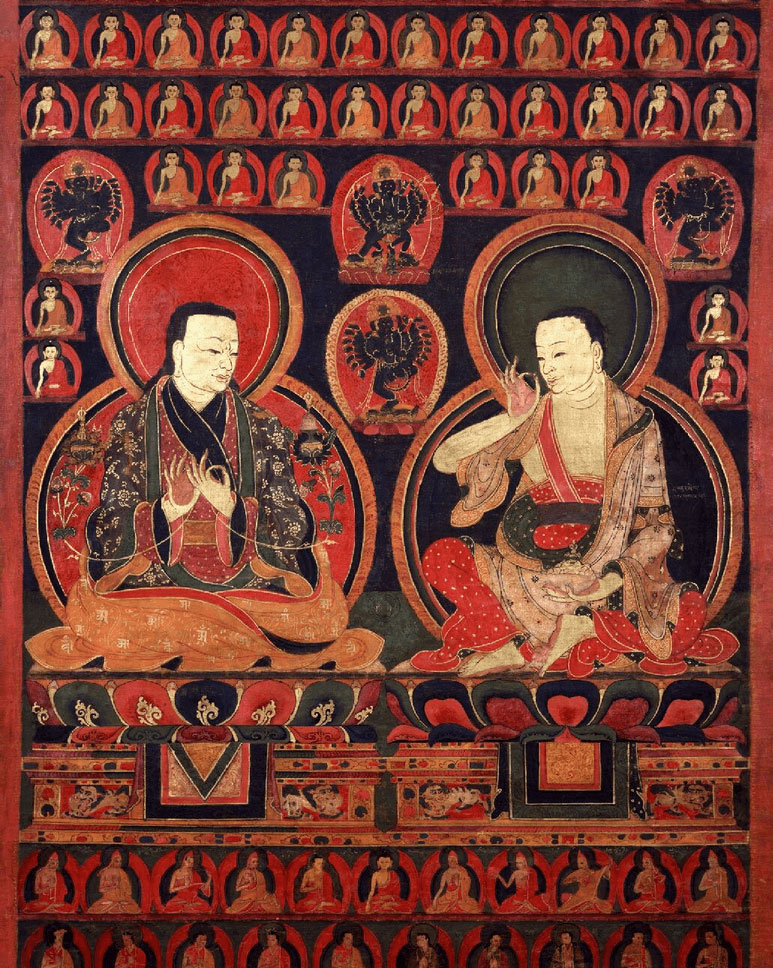
The Marpa Kagyu tradition originated in the eleventh century with the Tibetan translator Marpa Chokyi Lodro, who studied in India with Nāropa. Marpa’s disciple Milarepa famously attained enlightenment in the caves of southern Tibet after renouncing a life of violent revenge; his disciple Gampopa merged the lay siddha practice of his master with the Kadampa monasticism and scholarship that he had previously studied. Gampopa founded the first Kagyu monastery, Daklha Gampo in southern Tibet. Following Gampopa the tradition split into multiple autonomous subsects known as the four primary (Barom, Pakdru, Karma, and Tselpa), and eight secondary traditions (Drigung, Drukpa, Martsang, Shukseb, Taklung, Tropu, Yabzang, and Yelpa Kagyu), established by disciles of Pakmodrupa. The Drukpa Kagyu is further divided into Upper, Middle, and Lower. In addition to the above system, the Ngok (rngog) lineage begun by Ngok Choku Dorje, a disciple of Marpa, was a distinct Marpa Kagyu tradition that existed independently for several centuries. Also often considered an independent tradition was the Aural Lineage of Rechungpa, initiated by the disciples of Milarepa’s disciple Rechung Dorje Drakpa. The Barawa Kagyu tradition is considered a sub-branch of the Yanggon Kagyu, itself an offshoot of the Upper Drukpa. All Marpa Kagyu traditions claim allegiance to the tantric teachings of the Indian Mahāsiddha tradition, primarily that of Nāropa, in the form of the Six Yogas of Nāropa and the doctrine of Mahāmudrā. The Kagyu were also heavily involved in the transmission of the Cakrasaṃvara, Hevajra, among other tantras of the Second Propagation era.
Alongside the transmission lineage of Marpa is that of Khyungpo Neljor, who received Mahāmudrā teachings in India from Niguma, who may have been Nāropa's sister, and who accordingly taught the Six Yogas of Niguma. He established the monastery Zhangzhung Dorjeden in Tsang and initiated the Shangpa Kagyu tradition.